Post
Alpina Startimer – The newest 1 for best day
May
Alpina Startimer
The Alpina Startimer collection brings genuine aviation instrument design to the wrist — legible, robust, and surprisingly affordable for a Swiss pilot’s watch.
The Alpina Startimer collection is a tribute to the golden age of aviation. Alpina, a Swiss watchmaker founded in 1883, has a long history of producing precision instruments for professionals, including pilots, explorers, and military personnel. The Startimer line — with its bold, highly legible dials, large crowns, and reliable automatic movements — embodies the “cockpit instrument” philosophy. In an era where pilot’s watches can cost thousands of dollars, the Startimer offers Swiss-made quality for a fraction of the price (typically $500–$1,200). Whether you are an actual pilot, an aviation enthusiast, or simply someone who appreciates functional, masculine design, the Alpina Startimer is a compelling choice.
1. Alpina’s History: The “Four Fundamentals” of Sport Watches
Alpina was founded by Gottlieb Hauser, and in 1938, the brand introduced the “Alpina 4” concept: a sport watch that must be anti-magnetic, shock-resistant, water-resistant, and made of stainless steel. This philosophy laid the groundwork for modern tool watches. During WWII, Alpina supplied watches to the German Luftwaffe (yes, ironically) and later to various air forces. In the 1990s, the brand faded but was revived by the same group that owns Frederique Constant. Since then, Alpina has focused on accessible Swiss sports watches, including the Startimer pilot line. The Startimer name combines “Star” (celestial navigation) and “Timer” (chronometer).
2. Design Language: Pure Cockpit Legibility
The Startimer’s design follows aviation instrument principles: high contrast, large numerals, and minimal distractions. Dials are typically matte black or dark gray with white numerals (Arabic or luminous blocks). The hands are broad, sword-shaped, filled with Super-LumiNova. The minute track is clear. The crown is oversized (easy to operate with gloves). The case is 42mm or 44mm, with a brushed finish to reduce glare. Some models feature a date window at 3 o’clock, and the chronograph versions add two subdials. The bezel is fixed (no diver’s bezel), often with a tachymeter or second time zone scale. The overall impression is that of a watch designed for function first — and the aesthetic follows beautifully.
3. The Startimer Pilot Quartz: Entry-Level Reliability
The entry-level Startimer uses a Swiss quartz movement (Ronda 715 or similar). It is accurate, low-maintenance, and very affordable ($300–$500). The quartz models have a clean 3-hand dial with date. They are ideal for those who want the look and reputation without the need for automatic winding. The quartz Startimer also features the same 100m water resistance and sapphire crystal (on many models) as the automatic versions.
• Movement: AL-525 (Sellita SW200-1 base), automatic, 38h power reserve, 26 jewels
• Frequency: 28,800 vph (4 Hz) with hacking and hand-winding
• Water resistance: 100 meters (10 ATM) — suitable for swimming
• Case diameter: 44mm · thickness: 10.5mm · lug-to-lug: 50mm
• Case material: Brushed stainless steel
• Bezel: Fixed with grooves for grip
• Crystal: Sapphire with anti-reflective coating
• Dial: Matte black, Arabic numerals, Super-LumiNova hands
• Crown: Oversized, signed
• Strap: Brown or black leather with pin buckle
• Special: Swiss-made, inspired by cockpit instruments
4. The Alpina Startimer Chronograph: For Timing Flights
The Chronograph (Ref. AL-372) is the flagship of the line. It uses the AL-372 movement (based on Sellita SW500 or Valjoux 7750), a 25-jewel automatic chronograph with a 48-hour power reserve and a date function. The dial features two subdials (30-minute counter at 3, 12-hour counter at 9, with running seconds at 6 or 9 depending on model). The chronograph pushers are rectangular, easy to operate. The bezel often has a tachymeter scale. The chronograph adds a sporty, complex look without sacrificing legibility. It is also available in a “Big Date” version where the date window is larger and split into two apertures.
5. The Alpina Startimer GMT: Dual Time Zone for Jet-Setters
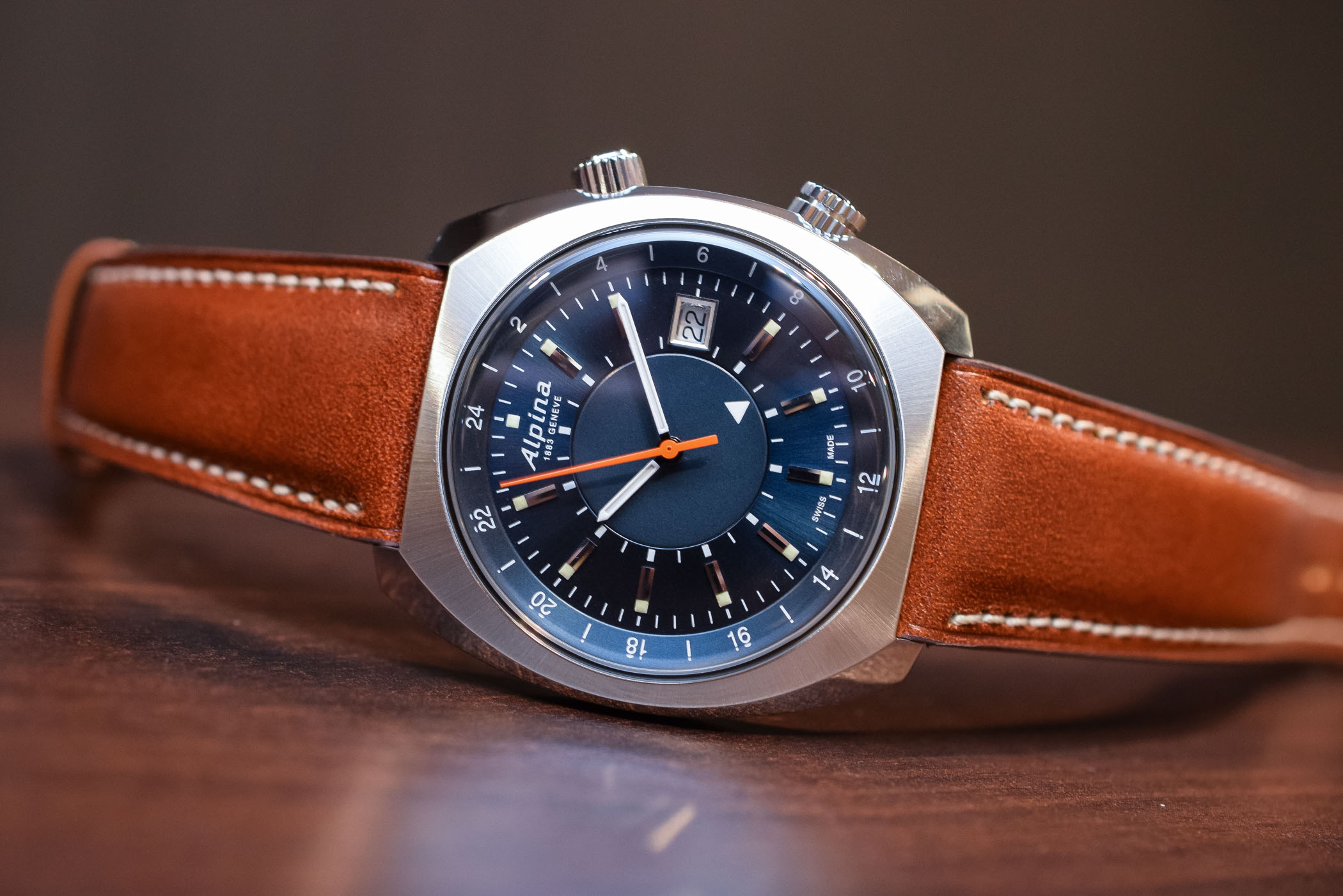
The Startimer GMT (Ref. AL-560) adds a fourth hand (GMT) and a 24-hour bezel or inner ring. The movement is the AL-560 (based on ETA 2893-2/Sellita SW330), with a 42-hour reserve. The GMT hand is often red or orange for contrast. The case is 44mm. This model is perfect for travelers who need to track two time zones. The GMT function is a “caller” GMT (independent 24-hour hand).
6. The Startimer Manufacture: In-House Movement
For those who appreciate true in-house watchmaking, Alpina offers the Startimer Manufacture (Ref. AL-710). This model uses the AL-710 caliber, an in-house automatic movement developed by Alpina (manufactured by Sellita under Alpina specification, but with Alpina-specific bridges and finishing). The movement has a 38-hour reserve and is visible through a sapphire caseback. The dial is more refined, often with a “clous de Paris” pattern. The Manufacture line is priced higher ($1,500–$2,500) and is aimed at collectors who value exclusivity.
7. The Alpina Startimer Heritage: Vintage Re-Edition
The Startimer Heritage models are direct homages to Alpina’s 1930s–1950s pilot watches. They feature a smaller case (40mm), a domed sapphire crystal, a hand-wound movement or automatic, and vintage-style hands and numerals. The Heritage has a warm, retro feel, often with a beige or cream dial. It is very popular among vintage aviation enthusiasts.
8. Wearing the Startimer: The Feel of a Cockpit Instrument
Put on a Startimer, and you immediately appreciate its simplicity. The large crown is easy to grip. The matte black dial never reflects glare. The white numerals pop. The lume is bright and long-lasting. The 44mm case is large but not excessive; the 42mm models fit most wrists. The leather strap is thick and comfortable (though stiff initially). The 100m water resistance means you can swim with it (though it is not a diver). The watch sits flat on the wrist, and the weight is moderate.
9. The Alpina Startimer vs. Competitors: Laco, Stowa, Hamilton, Tissot
The Startimer competes in the affordable pilot watch segment. Its main rivals:
• Laco (German, Flieger style, automatic, similar price) — more historically authentic (Luftwaffe designs), but movement quality similar.
• Stowa (German, higher finishing, more expensive, also historically authentic).
• Hamilton Khaki Aviation (similar price, also Swiss, but often smaller cases).
• Tissot Couturier (Swiss, similar price, but less pure pilot design).
The Startimer wins on Swiss heritage, availability, and the “instrument” aesthetic. Laco has a more hardcore aviation origin, but Alpina offers modern reliability and variety.
10. The Alpina Startimer in Pop Culture and Collecting
Alpina is not a flashy brand, but the Startimer has a loyal following among aviation enthusiasts and budget-conscious watch collectors. It has been featured in pilot magazines and is often recommended as a “first serious pilot watch.” The brand sponsors the “Alpina Startimer” hot air balloon team and has partnerships with aviation museums. Collecting Startimers is not about investment, but about functional beauty. Limited editions (e.g., “Startimer Heritage,” “Startimer Manufacture”) hold value slightly better.
11. The AL-525 Movement: Reliable Workhorse
The AL-525 is based on the Sellita SW200-1, a clone of the ETA 2824-2. It is a durable, accurate movement (usually ±10-20 sec/day). The rotor is decorated with Côtes de Genève, and the bridges have perlage. The movement has a 38-hour power reserve (less than modern 80-hour movements, but adequate for daily wear). It is easy to service by any watchmaker. The AL-525 is used in many Startimer automatics, offering excellent reliability for the price.
12. The Startimer Big Date: A Unique Complication
The Startimer Big Date (Ref. AL-560) features a large, split date window at 12 o’clock (two apertures). The big date is a design signature of Alpina and adds a distinctive look. The movement is the AL-550 (automatic with date). The big date is very legible and becomes a conversation point.
13. Straps and Bracelets: Versatility
The Startimer comes on a leather strap (cowhide or crocodile-grain) with a signed buckle. The strap is comfortable, but many owners swap to a NATO or metal bracelet. The lug width is 22mm (44mm case) or 21mm (42mm case). The watch is also available on a steel bracelet (H-link or oyster style) for a more robust look. The bracelet has a folding clasp with micro-adjustment. Aftermarket straps are plentiful.
14. Servicing and Value Retention
The Startimer is not an investment piece; it depreciates moderately (50-65% of retail after 5 years). However, the retail price is low (often under $800 for automatic versions), so the loss is manageable. Servicing the AL-525 costs $150–$250 by an independent watchmaker. The watch is durable; the sapphire crystal is scratch-resistant, and the steel case can be polished. Many owners keep the Startimer for a decade or more as a daily beater.
15. Conclusion: Honest Swiss Aviation
The Alpina Startimer is a refreshingly honest watch. It does not pretend to be a luxury icon; it is a tool — a reliable, legible, well-made pilot’s watch from a historic Swiss brand. It offers everything you need and nothing you don’t. The aviation-inspired design is pure and functional. Whether you choose the simple automatic, the chronograph, the GMT, or the heritage model, you are getting a piece of Swiss aviation heritage at an accessible price. For pilots, aviation buffs, or anyone who appreciates a clean, legible dial, the Startimer is a superb choice. It is the watch you reach for when you need to know the time, at a glance, in any light — no fuss, no hype, just precision.
